
Flow Measurement for
Industrial Testing Processes
Reliably Measure Flow and Safely Test Components
With the right flow measurement, it is possible to determine the volume of gas flowing through a component under specified conditions. This allows deviations to be reliably detected and components to be evaluated based on defined threshold values.
HeMaTech develops solutions for industrial flow measurement technology—from individual flow meters to the integration of measurement into automated testing and production processes.
Precise measurement. Reproducible test procedures. Tailored to your application.
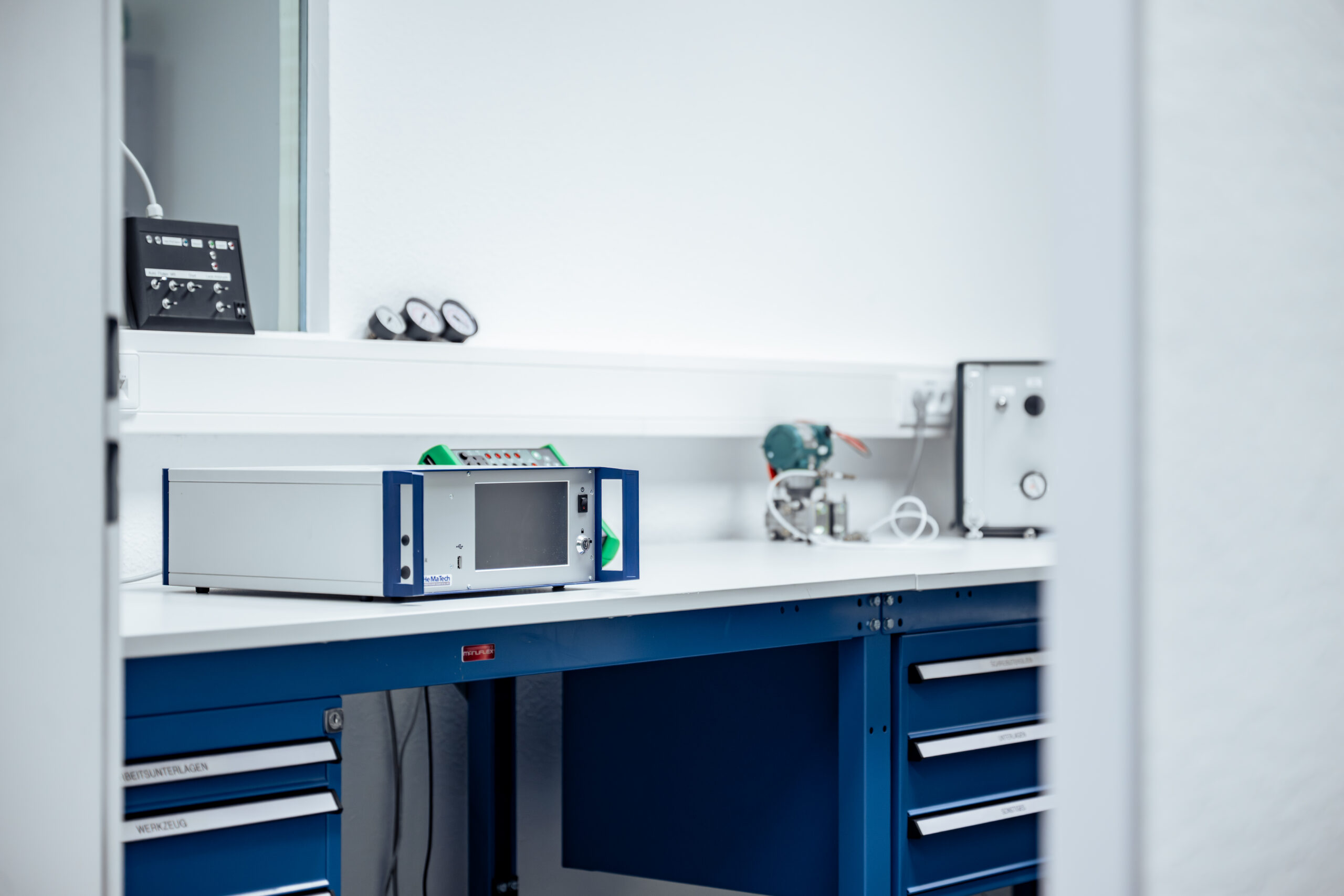
Industrial Flow Measurement
It provides a quantifiable measurement value that can be used, for example, for functional tests, quality control, or pass/fail decisions.
Typical test objects include, among others:
That is why HeMaTech does not just look at individual measurement values. We consider the entire test process—from the component and its connections, through the test parameters, to the evaluation and potential integration into your manufacturing process.
What is flow measurement?
In industrial testing, this value can be used to evaluate the performance of a component.
A simple example is a valve: Under specified conditions, a certain flow rate must be achieved. If the measured value falls outside the specified limits, this may indicate a deviation in the component or its function.
Thus, flow testing provides a measurable quality parameter.
Our 3925-0160 Flow Meter
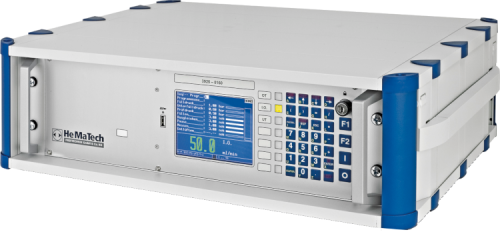
For industrial flow measurement, HeMaTech offers, among other products, the 3925-0160 flow meter.
The device uses a thermal mass flow meter. It operates based on the relationship between the flow of a gas and the resulting heat transfer.
A portion of the gas flow is routed through a bypass sensor, which contains thermal resistance elements. The heat transfer caused by the flowing gas creates a temperature difference, from which the mass flow rate is determined.
The key advantage for industrial testing is that the mass flow is measured directly.
Unlike purely volumetric measurements, determining the mass flow does not require additional temperature and pressure sensors to correct for the volume flow.
This creates ideal conditions for compact and reproducible industrial testing processes.
How does thermal flow measurement work?
In the flow meter, the gas flow is divided into a main stream and a bypass stream. The bypass stream is directed through a bypass sensor. Thermal resistance elements are mounted on a thin stainless steel tube, while the gas flow is heated by constant-power heaters.
When gas flows through the system, heat is transferred. This causes a change in the temperature distribution between the measuring elements.
The resulting temperature difference is directly related to the mass flow rate.
A precision laminar flow element and the design of the measuring tube and bypass ensure that the flow conditions required for the measurement principle are created.
The result is a directly evaluable measurement value that can be used to assess the test specimen.
Mass flow or volumetric flow
Volume flow describes the volume of a medium that passes through a cross-section within a given time. For gases, however, the volume can vary with pressure and temperature.
Mass flow, on the other hand, describes the actual mass transported per unit of time.
The HeMaTech 3925-0160 flow meter operates on the thermal principle and directly measures the mass flow. This eliminates the need for additional temperature and pressure sensors to correct a volumetrically measured flow rate.
Which measurement parameter is critical for a specific testing process should always be determined based on the actual product and quality requirements.
Typical Applications of Flow Measurement
The appropriate method depends primarily on the permissible leakage rate and the conditions of the specific application.
The HeMaTech documentation distinguishes, among other things, between pressure change measurements using relative/absolute pressure transducers and the differential pressure method.
A flow test, for example, makes it possible to assess whether the intended gas flow is achieved under defined conditions. This allows deviations to be detected within a reproducible test procedure.
Industrial flow measurement provides a quantifiable value for this and enables testing against specified tolerances.
Flow can be an important quality parameter, particularly for components with defined cross-sections, bores, branches, or structurally specified flow paths.
This allows for verification that the gas flow is within the specifications defined for the product.
The appropriate test method and parameters always depend on the specific application.
Flow Measurement as a Functional Test
The measured flow rate can be directly linked to the component’s function.
For example, if a specific volume of gas is to flow through a channel,
the measured value can be used to verify whether this requirement is met.
This can lead to defined limit values for the testing process:
Measured value within tolerance:
The component meets the specified requirement.
Measured value outside tolerance:
The component must be evaluated or rejected according to the defined test strategy.
In automated production processes, this decision can be directly integrated into the subsequent manufacturing sequence.
In this way, flow measurement becomes an integral part of industrial quality assurance.
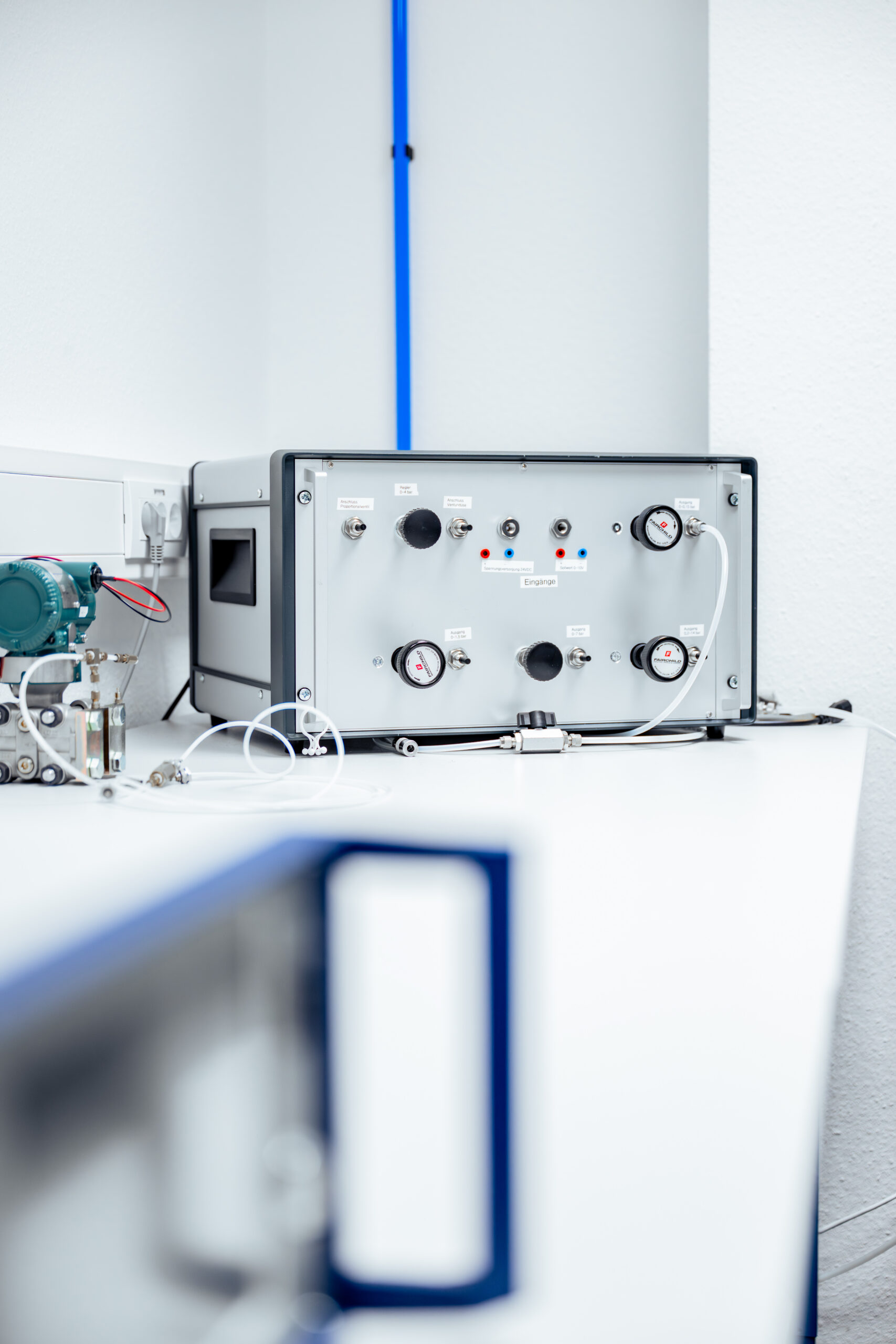
From Flow Meters to Complete Testing Solutions
For flow measurement to function reliably in day-to-day production, other factors must be taken into account.
These include, for example:
Automate Flow Measurement
The 3925-0160 flow meter is therefore designed for automated test sequences.
Depending on the application, test programs can be saved, and test pressures and test times can be adjusted for different components.
With further automation, flow measurement can become an integral part of a complete test station or test system.
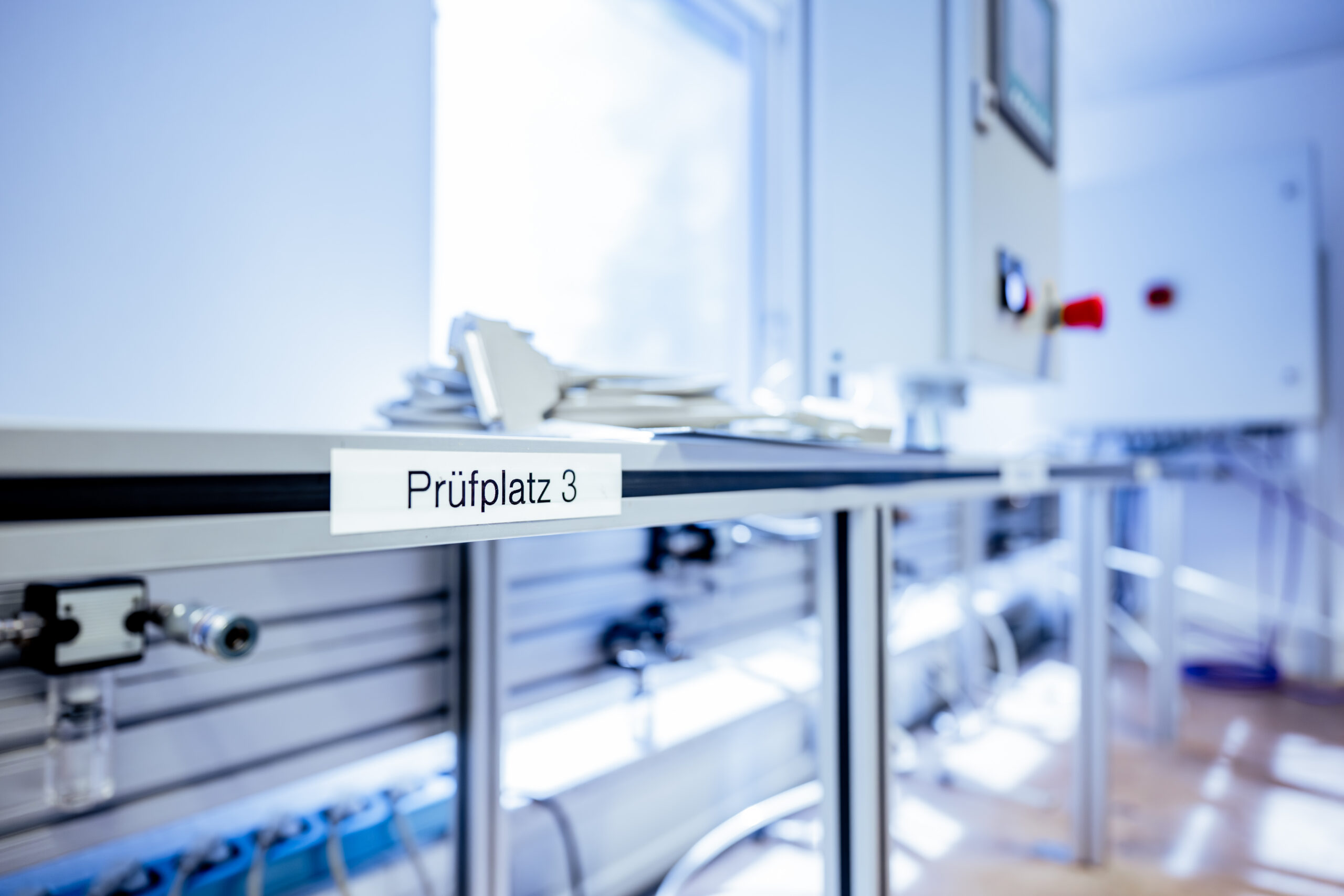
Flow Testing for Mass Production and Custom Testing Tasks
Depending on the quantity, the testing task, and the existing manufacturing concept, the following options are possible, for example:
The operator loads the component, makes contact with it, and starts the test process. The measuring device performs the actual measurement and evaluation.
Semi-Automatic Test Station
Certain process steps, such as clamping, sealing, or the test sequence, are automated, while the workpiece continues to be loaded manually.
Fully Automatic Test System
Workpiece handling, contacting, measurement, evaluation, and onward transport areall automated.
In-line Flow Test
The flow test is directly integrated into an existing production line and takes place as part of the manufacturing process.
Test equipment, apparatus, and automation resulting from a coordinated process
This is particularly relevant for applications in which the flow meter is not intended to be operated in isolation.
For example, a specific testing task can lead to a solution that integrates the measuring device, mechanical mounting, sealing, sensor technology, control systems, workpiece handling, and data acquisition.
Depending on the project, we can support the process from technical design through to integration.
This provides you not only with a way to measure flow, but also with a testing process tailored to your manufacturing operations.
Reliably measure flow and integrate it into the testing process
We combine industrial flow measurement technology with test fixtures, test automation, calibration, and service. This allows us to develop a solution for a specific testing task, ranging from a single measuring device to an integrated test system.
Talk to us about your component.
HeMaTech Prüftechnik GmbH & Co. KG
Siemensstr. 7
D-71409 Schwaikheim
Frequently Asked Questions About Flow Measurement
What is flow measurement?
Flow measurement determines the volume of a fluid that flows through a defined cross-section within a specific time period. In industrial testing, the measured flow rate can be used as a functional or quality characteristic of a component.
Which components can be tested using flow measurement?
Typical applications include valves, fittings, pipe assemblies, exhaust systems, piping systems, and other fluid-carrying components. In general, a flow test is considered appropriate when a defined gas flow through the component is a relevant functional or quality characteristic.
How does the HeMaTech flow meter work?
The HeMaTech 3925-0160 flow meter uses a thermal mass flow sensor. A portion of the gas flow is directed through a bypass sensor. The heat transfer caused by the flow creates a temperature difference, which is used to determine the mass flow rate.
What is the difference between flow measurement and leak testing?
Flow measurement involves quantitatively determining an existing gas flow. Leak testing, on the other hand, involves determining whether—and to what extent—the medium is escaping from undesirable locations. Which method is appropriate depends on the specific testing task.
What is the difference between mass flow and volumetric flow?
Volume flow describes the volume of a medium per unit of time. Mass flow, on the other hand, describes the mass transported per unit of time. Since the volume of gases can change with pressure and temperature, these factors must be taken into account accordingly in volumetric measurement methods. The HeMaTech 3925-0160 measures mass flow directly using the thermal principle.
Can flow measurement be automated?
Yes. The 3925-0160 flow meter supports automatic test sequences and the storage of test programs. In addition, the measurement can be integrated into semi- or fully-automatic test stations as well as into existing manufacturing processes.
Can a flow test be integrated into an existing production line?
Yes. Depending on the application, flow measurement, workpiece clamping, sealing, handling, control, data acquisition, and pass/fail evaluation can be combined into an automated testing process. The specific integration depends on the available interfaces and process conditions.
What factors are important when selecting a flow meter?
Key factors include the component to be tested, the medium used, the required measurement range, the test pressure, the permissible tolerances, the desired test time, and integration into the production process. For automated applications, cycle time, interfaces, and workpiece handling are also important considerations.
Can HeMaTech also develop a complete test system for flow measurement?
Yes. In addition to individual test instruments, custom test setups and complete test processes can be implemented. When combined with automation technology, the measurement can also be integrated into automated test stations and production lines.
How can a flow meter be checked?
Measuring and testing equipment should be checked regularly as part of the respective quality assurance program. HeMaTech offers calibration and maintenance services for this purpose. The 3925-0202 leak calibrator can be used, among other things, to check flow meters.
Can the flow measurement be used for different component variants?
That depends on the specific components and testing requirements. With the 3925-0160 flow meter, test programs can be saved, and test pressures and test times can be adjusted. For custom systems, additional fixtures and automation can be adapted to different configurations.
How do I start a project involving industrial flow measurement?
It is best to start by compiling the available information about the component and the testing task. Particularly helpful are drawings or images, the desired measurement range, test pressure, tolerances, cycle time, quantities, production conditions, and information regarding the desired automation. Based on this information, the technical solution can be developed in more detail.