For industrial manufacturing processes

Labeling Systems

We develop marking systems for permanent labeling and integration into production processes—from laser stations to fully automated marking cells.
To our 3D models
Permanently Mark Components

Series production and special-purpose machinery

In modern manufacturing processes, components must remain uniquely identifiable. Serial numbers, Data Matrix codes, or component markings are integrated directly into production lines to ensure traceability and process reliability.
That is exactly why we develop custom labeling systems for industrial applications.
Depending on the application, we implement:
Our systems are designed for, among other things:
Automotive
Medical Technology
Plastics Technology
Fluidics
Electrical engineering
Battery and e-mobility applications
Developing Labeling Systems for Streamlined Workflows

Traceability and Component Identification

Marking processes must be performed in a way that ensures permanent legibility, reproducibility, and precise positioning. Especially when dealing with small components or short cycle times, the integration of the marking process is critical to the stability of the entire production process.

That is why we develop labeling systems that are precisely tailored to the workpiece, the material, and the production environment.
Our systems can be fully integrated into existing manufacturing processes—including robotics, PLC control, and automated workpiece transfer.
Methods used include, among others:

Data Matrix Code (verify / check quality)

Laser Marking
QR Code Labeling
Serial Number Marking
Plain-text labeling
Component Marking
automatic workpiece positioning
Sensor-monitored labeling processes
In doing so, we take into account not only the actual marking process, but also workpiece handling, positioning, cycle time, and integration into existing production lines.
Developing Labeling Systems for Streamlined Workflows

Industrial Production Lines

Marking systems must be permanently legible and integrated into industrial manufacturing processes in a way that meets cycle time requirements. That is why we do not develop standard systems, but rather customized solutions for specific production tasks.

We integrate workpiece positioning, automatic component feeding, marking inspection, code reading, workpiece handling, data acquisition, process monitoring, and the removal of defective parts.
This is achieved through workpiece carrier systems, camera systems, PLC control, safety and operator interface concepts, visualization systems, robotic handling, and process data acquisition.
This is how labeling processes are developed for stable, reproducible industrial mass production.
Using Robotics for Labeling Processes

Robotic Cells and Automation for Laser Marking

Complex production processes often require automated workpiece movement and defined handoff procedures. That is why we combine marking systems with robotics and automated handling systems.
For example, our robot cells handle:
automatic workpiece feeding
Component Positioning
Transfer to Labeling Systems
Rejection of faulty parts
automated process handovers
Chaining of Multiple Production Steps
In doing so, we integrate servo-electric axes, sensors, camera technology, and PLC controls into a complete automation solution.
Many systems are designed specifically for high cycle rates or complex workpiece geometries, where manual marking processes reach their limits.
Adapt Labeling Systems to Production Conditions

Custom Labeling Systems

Every manufacturing operation has different requirements for marking, workpiece handling, and equipment configuration. That is why we develop custom machines for industrial marking processes.
We do not produce universal, off-the-shelf solutions, but rather technical systems tailored to specific production conditions and manufacturing processes.
Our services in special-purpose machine building include:
Project Examples in Laser Marking

Labeling Systems for Data Matrix Codes and Serial Numbers

Many of our labeling systems are designed for applications with high requirements for readability, process stability, and cycle time.
The examples and models shown here provide insight into the design, workpiece handling, and technical processes of our marking systems:

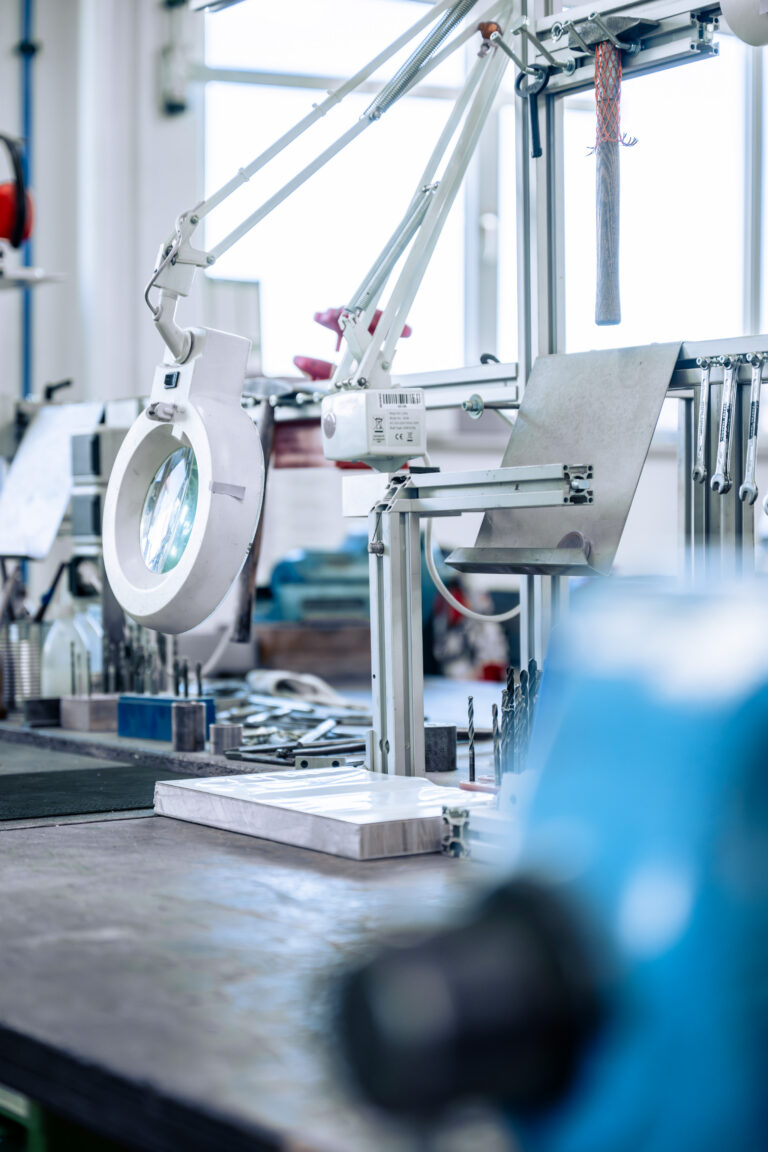
Laser Marking System for Automotive Components
Show DetailsView 3D Model
Documenting Technical Standards

Quality Management

Our automation solutions must function reliably and consistently over the long term. That is why, even during the development phase, we ensure documented project workflows, structured technical design, traceable process steps, and service-friendly system concepts.

This is complemented by stable production processes, technical documentation, and defined testing, acceptance, and control structures for long-term use in industrial production environments.
Documenting Technical Standards

Certifications and Requirements

Depending on the industry and production environment, different requirements apply to traceability, documentation, and technical traceability.
Our experience includes, among others:
ISO 9001:2015 Certificate
Our experience includes, among others:
Planning Labeling Processes Together

get in touch

Would you like to mark components automatically, expand your existing marking systems, or develop a custom laser marking solution for your manufacturing process?
Then talk to us about your requirements. Together, we’ll analyze the workpiece, the marking process, the cycle time, and the production environment—from individual laser workstations to fully automated marking cells.
Request a project now
Frequently Asked Questions About Laser Marking

FAQ on Labeling Systems, Marking, and Automation

Laser Marking System for Automotive Components

  • Laser Marking of Data Matrix Codes (DMC)
  • Integrated verification of the labeled code
  • Rotary table system for simultaneous component change during marking
  • Integrated into a customer-side robotic cell
10695 - HeMaTech Prüftechnik GmbH & Co. KG - Download